A Brand Communication Framework for School Leaders Before You Apply the 4D Framework, You Must First Diagnose Where Your School Stands right now
An EdMonks Guide: how to increase school admissions in India
The 4D Framework
Define → Declare → Display → Dominate
Before You Read This Guide
Whenever I get a call from a school owner in admission distress, and they want my help on how to increase school admissions in India, without exception they tell me they have already tried hoardings, website improvement, social media ads, and teacher referral programs. They report having decent infrastructure and a good admission counsellor. Still no growth. I understand immediately what is missing: they have never explored brand communication.

That is why, when I decided to write this guide: how to increase school admissions in India, I wanted to make sure this was not that list you have already tried and failed at. I wanted to let you see all these ideas differently. After working with several schools across India, I know what moves admissions and what just moves money.
This guide operates on a different premise: admission growth is not a marketing problem. It is a brand communication problem. And brand communication, done correctly, is a function of positioning, not promotion.
Here is something I see in almost every school. The principal wants to build real academic achievements first and then talk about them. Fair enough. But the management, worried about this year’s admissions, starts running ads before those achievements are even ready. So the communication gets ahead of the substance. Or the substance never gets communicated at all. What is missing in the middle is brand-led thinking. And that missing piece is exactly why so many good schools are losing to schools that are not nearly as good. If that sentence stings a little, this guide is for you.
A note on why I am sharing this:
Honestly, I started writing this because I was tired of seeing schools make the same expensive mistakes year after year. If sharing this framework freely means one school stops wasting its budget on hoardings that do not work, that feels worth it. And if it means you eventually trust EdMonks enough to work with us, even better. At EdMonks, we teach this framework inside our paid School Growth Program. I am sharing the core logic here because I believe in demonstration before invitation.
How to Use This Guide
This guide is structured in five sequential steps. Do not jump ahead.
The temptation when admissions are under pressure is to skip straight to tactics. Resist it. Schools that do this spend money without building equity.
| Step | What It Covers | Why It Matters |
|---|---|---|
| Step 1: Diagnose | Understand your school’s current market position using the 8-Level Ladder | Read first. This determines everything that follows. |
| Step 2: Define | Clarify your brand positioning, what your school truly stands for | Foundational. All communication flows from here. |
| Step 3: Declare | Identify and articulate your real differentiation | This is where most schools fail. Do not rush this step. |
| Step 4: Display | Build your communication architecture: Outbound, Inbound, Wombound | Execution layer. Only effective after Steps 1 to 3 are complete. |
| Step 5: Dominate | Protect and evolve your brand position over the long term | The compounding phase. Where brand equity is built. |
Note on the framework name: The 4D Framework refers to Define, Declare, Display, and Dominate. Diagnose sits before the framework as a prerequisite. Think of it as the assessment that tells you where to enter the framework. A doctor assesses before prescribing. Same logic applies here.
Step 1: Diagnose | Where Does Your School Stand Today?
Schools never really want to opt for consulting. And when they finally do, it is usually because they have been applying the wrong solution to a solvable problem for too long. Facebook ads do not solve a trust deficit. A new tagline will not stop your school from bleeding admissions. If your school has been around for more than three years, a massive advertising push will not move your enquiry numbers the way you hope.
Schools fail not because of bad campaigns. They fail because leadership applied the wrong strategy for their actual stage of growth.
I have mapped the school growth journey into two modes and eight distinct levels. Read each one carefully. Then commit to an honest assessment of where you currently sit.
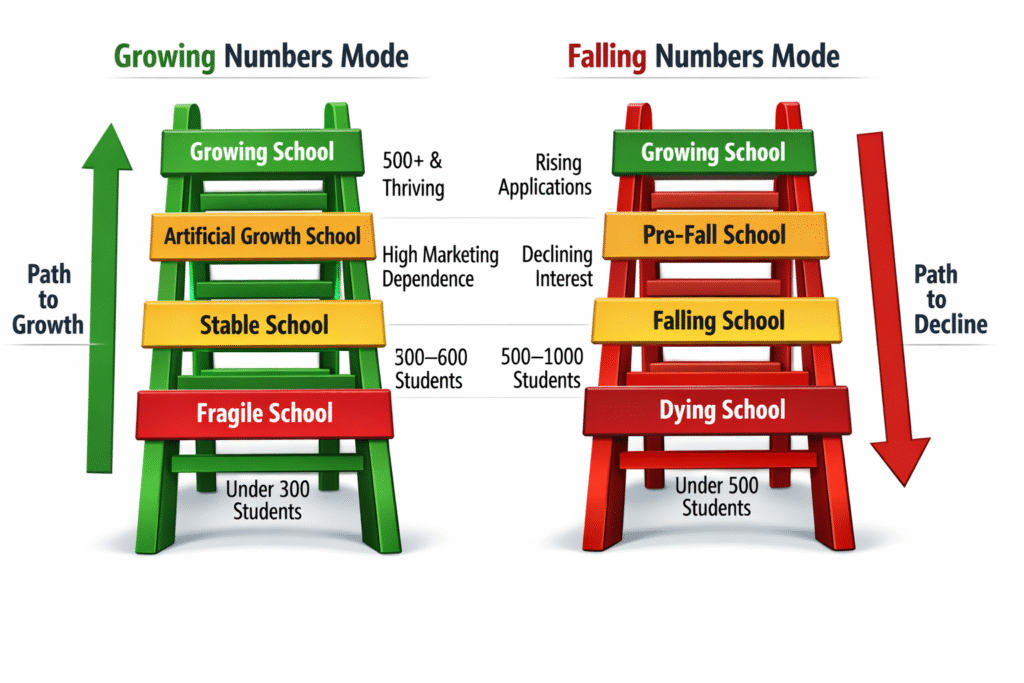
Mode A: Growing Numbers
These are schools that are relatively new, typically under ten years old, and are actively building their student base and reputation.
Level 1: The Fragile School (Under 350 students, 3 or more years old)
| You are here if | Applications are thin. Fee discounts are being offered to attract families. Staff turnover is high. Parents ask probing questions about the school’s future. |
| Core problem | Trust deficit. The school has not yet demonstrated consistent delivery of its promise. |
| Your number one priority | Build visible proof of quality. Not through advertising, but through parent testimonials, small wins, and community trust-building moments. |
| Do not do this | Offer fee discounts or free admission to fill seats. This signals desperation, not value. Once the price anchor is set low, it is very difficult to raise. In Tier 2 and Tier 3 cities especially, falling below 350 students also makes it hard to retain quality CBSE-qualified teachers, because salary competitiveness drops sharply at that point. |
| Communication posture | Hyper-local. Build trust within your immediate 3 km radius before you think about reach. |
Level 2: The Stable School (350 to 500 students)
| You are here if | The school is operationally functional. Teachers are settled. You are no longer fighting for survival, but growth feels slow and unpredictable. |
| Core problem | Identity blur. The school exists but has not built a clear, distinct reputation in the market. |
| Your number one priority | Refine your positioning. Understand what you want to be known for and begin communicating it consistently across every parent touchpoint. |
| Do not do this | Try to be everything to everyone. A school that claims excellence in academics, sports, arts, technology, and values all at once is remembered for none of them. |
| Communication posture | Begin building an inbound content strategy. Parents researching schools in your city should be able to find you and understand your philosophy. |
Level 3: The Artificial Growth School (500 or more students, driven by ads and teacher referrals)
| You are here if | Admissions are growing but the school spends heavily on banners, brokers, canvassing, and teacher-driven enrollment. Remove the advertising budget and the numbers will fall. |
| Core problem | Growth without brand equity. The school is buying admissions, not earning them. |
| Your number one priority | Shift from persuasion to reputation. Identify what genuinely differentiates your school and start building communication around that, not around offers and facilities. |
| Do not do this | Increase the advertising spend. That only deepens the dependency. Invest instead in parent experience that generates word-of-mouth. |
| Communication posture | Transition from Outbound-heavy to a balanced Outbound plus Wombound strategy. This is explained in detail in Step 4. |
Level 4: The Organically Growing School
| You are here if | Admissions grow because parents refer. Your brand carries credibility without heavy advertising. Waiting lists exist in some grades. |
| Core problem | Maintaining authenticity and innovation as the school scales. Complacency is the enemy at this stage. |
| Your number one priority | Protect your brand positioning. Continuously invest in differentiated practice. Communicate it consistently. Do not coast. |
| Do not do this | Standardise everything in the name of efficiency. Organic growth is fuelled by distinctive culture. Protect what makes you different as you scale. |
| Communication posture | Heavy Wombound plus Inbound. Advertising is a small, targeted supplement. |
Mode B: Falling Numbers
Never be a leader who only wants to explain the situation away. When I ask school principals why their admission numbers are falling, the answer is almost always “growing competition.” That is never the full answer. The big school brands of India are never short of admission numbers. Competition exists for all of them too.
These schools have an established history but are experiencing declining enrollment. The root cause is almost always a gap between what the market now expects and what the school is delivering. Competition has not taken your admissions. The market has moved and the school has not.
Level 5: The Pre-Fall School (Full classrooms, but thinning applications)
| You are here if | The school is still at or near capacity, but the annual application pool is shrinking. Enquiries are down. Walk-ins are fewer. New schools nearby are absorbing the families you would previously have enrolled. |
| Core problem | Invisible erosion. Everything looks fine today. The problem is 2 to 3 years away, and by the time it becomes visible, recovery will be far harder. |
| Your number one priority | Act now. Begin a full brand positioning audit. Understand what perception exists in the market today and what needs to change. |
| Do not do this | Wait for numbers to fall before acting. Pre-Fall is the best time to intervene because you still have resources and reputation to work with. |
| Communication posture | Begin investing in Inbound and Wombound immediately. Re-activate existing parent communities as brand advocates. The March-April admission season in India is your visible deadline. Work backward from it. |
Level 6: The Failing School (500 to 1000 students, declining year-on-year)
| You are here if | Year-on-year enrollment is clearly falling. Leadership meetings increasingly focus on filling seats. Blame is directed at competition, regulatory changes, or economic conditions. |
| Core problem | Internal decay masked by external blame. Culture has eroded. The school’s identity is unclear. Parents who once advocated are now silent or leaving. |
| Your number one priority | Stop defending the past. Conduct an honest internal audit. What has changed in our culture, our teaching, our responsiveness to parents? Rebuilding communication without rebuilding substance will not work. |
| Do not do this | Launch a large-scale advertising campaign. Advertising a weakened brand only accelerates negative perception. Fix the product before amplifying the message. |
| Communication posture | Internal communication first. Rebuild staff alignment and parent trust before any external campaigns. |
Level 7: The Dying School (Below 500 students, continued decline)
| You are here if | Enrollment has fallen below 500. Financial sustainability is under stress. Staff morale is at its lowest. |
| Core problem | Loss of institutional credibility. The gap between what the school promised and what it delivered has become visible to the market. |
| Your number one priority | Radical honesty. Leadership must acknowledge what went wrong. A genuine recommitment to core values, demonstrated through actions and not announcements, is the only path forward. |
| Do not do this | Attempt a rebrand through visual identity alone: new logo, new website, new tagline. The market will not be fooled. Trust is rebuilt through sustained behavioural change, not cosmetic redesign. |
| Communication posture | Hyper-focused, community-rebuilding communication. Small genuine wins, documented and shared consistently. External help is strongly recommended at this stage. |
Level 8: The Organically Strong School
| You are here if | Applications are growing. Parent satisfaction is high. The school is seen as a benchmark in its category in the city. Leadership is forward-looking. |
| Core problem | The positioning game never ends. Complacency, or over-expansion without care, can move a Level 8 school to Level 5 within 2 to 3 years. |
| Your number one priority | Continue investing in differentiation and communication. Map the competitive landscape annually. Stay ahead of the market’s evolving expectations. |
| Do not do this | Confuse current success with permanent security. Every organically growing school that declined started from a position very similar to yours. |
| Communication posture | Thought leadership, community building, and consistent innovation storytelling. |
Key insight: This is not a static ladder. Schools move between levels, both upward and downward, within 2 to 3 academic years. The direction depends almost entirely on whether leadership is making proactive or reactive decisions.
Self-Assessment: Which Level Are You?
If you really want to improve your school brand, take this assessment. You are not doing it for a consultant or for a management board. Do it for yourself and be completely honest.
A word of caution: many school leaders answer “yes” to questions like “Are your existing parents your strongest marketing channel?” based on perception alone, without examining the evidence. If there is any doubt, I would strongly recommend an external brand audit rather than self-scoring your way to a comfortable answer.
Yes = 1 point. No = 0.
- Are your annual applications growing year-on-year?
- Do parents refer other families to your school without being asked?
- Could you reduce your advertising spend by 50% without a significant drop in admissions?
- Do you have a clear one-sentence articulation of what makes your school different?
- Are your existing parents your strongest marketing channel?
- Is your school’s reputation discussed positively in local parent communities and WhatsApp groups?
- Do you have documented proof of your school’s impact on students, beyond exam results?
- Is your teaching staff aligned with and vocal about the school’s identity and mission?
- Are you investing in any form of structured brand communication?
- Do you have a clear plan for the next 2 to 3 years of school growth?
| Score | Where You Are | Where to Focus |
|---|---|---|
| 8 to 10 | Organically Growing | Dominate phase. Protect and evolve your positioning. |
| 5 to 7 | Stable or Artificial Growth | Define and Declare phases. Strengthen brand roots. |
| 3 to 4 | Fragile or Pre-Fall | Urgent attention needed. Begin with Define phase immediately. |
| 0 to 2 | Failing or Dying | External intervention recommended. Do not delay. |
Step 2: Define | What Does Your School Stands For?
In January 2017, when I was new to the school space, I offered a one-week free WhatsApp-based MOOC on building a school brand. To my astonishment, 40 school principals joined, including leaders from DPS, GD Goenka, and many independent schools. Three joined from abroad: two from the UAE and one from Malaysia. In one activity, I asked them all to write a one-line brand positioning for their school.
32 out of 40 used the phrase “holistic education.” 23 wrote “project-based learning.” 17 wrote “future ready.” 12 wrote “excellence.” Only 3 or 4 respondents were genuinely clear on what they stood for.
That is the state of school branding in India today.
These answers are not wrong. They are just indistinguishable from what every other school says. You cannot own “holistic education” in a parent’s mind. It means everything and nothing at the same time.
Brand positioning is not about what you do. It is about what you own in the mind of the parent. A school that owns a specific idea, a clear and credible belief about education, wins the long game.
The Two Paths to Admission Growth
Before you define your positioning, you must make a strategic choice about how you want to grow.
| Advertising-Led Growth | Brand-Led Growth | |
|---|---|---|
| Logic | Research what parents want, promise to deliver it, advertise loudly | Decide what you stand for, build proof of it, attract parents who share your belief |
| Communication | Outward-push: ads, hoardings, canvassing, pamphlets at traffic signals | Inward-pull: reputation, referrals, content |
| Growth pattern | Proportional to spending | Self-sustaining over time |
| Parent type attracted | All kinds, including those who leave when a cheaper option appears | Aligned families who become long-term advocates |
| Long-term cost | Requires increasing investment each cycle | Requires decreasing investment as brand equity grows |
| Result | A local school business that competes on price and facilities | A distinctive school brand with pricing power and loyalty |
This is not a judgment. Which path you choose depends on your vision. If you want to build a school that is genuinely differentiated, known for its work at least in its city if not across an entire geography, you will choose a brand-led approach. If your vision is to run a local school business with urgency and without the ambition of becoming the best in the city, advertisement-led growth will serve you in the short term.
One important clarification: brand-led growth does not mean abandoning advertising. It means advertising becomes a very small part of the overall effort. The centre of gravity shifts from Outbound to Wombound marketing. More on this in Step 4.
But if your ambition is to build a school brand that becomes the automatic choice in your market, Brand-Led Growth is the only path that gets you there.
Why Brand-Led Growth Requires More Than Communication
This is the part of the conversation where I often lose people. Not because they disagree. But because it requires them to admit that the problem is not their marketing agency. It is the product itself.
I have seen this pattern repeatedly. School leaders nod when I say academics alone is no longer enough to build a great school brand. They genuinely agree in the room. And then they go back and do not change a thing about the school, because deep down they still believe their school is the right product and the challenge is just communication.
If that were true, you would not be struggling for admissions.
You cannot build a brand-led school on communication alone. If your school does not do anything genuinely different from the schools around you, even the most sophisticated communication strategy will underperform. Because you will have nothing distinctive to communicate.
Brand-led growth follows a specific sequence.
Innovate first. Build proof. Then communicate.
Communication not backed by genuine differentiation is just noise. And in a market where every CBSE and ICSE school in your city is making similar claims about smart classrooms, experienced faculty, and holistic development, noise is invisible.
A good deed unseen is like a peacock dancing in the forest. But a mediocre deed advertised loudly is even worse. It creates expectation without the ability to deliver.
This is why we have written a companion guide specifically on school innovation.
[Read: How to Build an Innovative School | A Framework for K12 Leaders in India] (Link to Guide 2 when published)
That guide covers the three levels of school innovation: Efficiency, Experience, and Disruptive. It gives you a practical framework for identifying and executing differentiated practices that are actually worth communicating.
For now, let us assume you either have some genuine differentiation already or are committed to building it. Because everything that follows in this guide only works if that foundation is real.
The Positioning Triangle
Strong school brand positioning sits at the intersection of three elements.
| Element | What It Means |
|---|---|
| What you genuinely believe | Your educational philosophy, not borrowed from a brochure, but lived daily in classrooms, assemblies, and parent meetings. |
| What you are uniquely capable of | The specific strengths of your team, your pedagogy, your culture, and your community that others cannot easily replicate. |
| What parents in your market actually value | Not what you assume they value. What they actually say, search for, and make decisions based on. |
The gap between these three elements is where most schools lose their positioning. They build communication around what they believe without validating it against what the market values. Or they chase what the market wants without the capability to deliver it.
How to Build Your Positioning Statement
A useful school positioning statement answers four questions.
- For whom: Who is your school specifically for? Not “all children.” Be specific about the kind of family and child you serve best.
- Belief: What is the specific educational conviction that drives everything you do?
- Delivery: How do you deliver on that belief in a way that others around you do not?
- Proof: What is the outcome that parents and students can expect and verify?
Template:
“[School Name] is built for [specific type of family or child] who believe that [core educational philosophy]. We achieve this through [specific differentiating approach], resulting in [meaningful, provable outcome].”
Example:
“Greenfield School is built for families who believe that a child’s confidence matters as much as their marks. We achieve this through project-based, inquiry-led classrooms and a no-comparison assessment model, resulting in students who are internally motivated rather than externally ranked.”
A positioning statement is not for your website homepage. It is your internal compass. Every communication decision, from how you conduct school tours to how you write your admissions brochure, must align with it.
Step 3: Declare | What Is Your Real Differentiation?
Positioning is what you decide to stand for. Differentiation is what you can prove you do differently.
Many schools confuse the two. A school can position itself as innovative but have no differentiated practice to point to. When that gap exists, the market senses it and trust erodes.
Differentiation without proof is just a claim. Proof without communication is just a secret. The goal of this step is to identify your real differentiators and build a proof portfolio around them.
The Differentiation Audit: Three Questions
I have encountered this situation many times. A school management walks in proud of their robotics lab or their English-speaking program, calling it their differentiation. I ask them: can you name even one serious competitor in your city that does not have something similar? The room goes quiet.
Ironically, the same schools rarely claim their music program as a differentiation. But if you have a music program and you make it the best in the city, that is a genuine differentiator. I recall working with a school in Haryana that had excellent sports facilities. But they felt they could not position as a sports school because the city already had a strong government sports facility. So I asked them: why not position as a private military education school? Connected them to an entity that specialises in exactly that. That reframe changed everything for them.
People do not want to ask the intriguing questions. They want the easy answers. The easy answers are always the wrong ones.
Run your school through these three diagnostic questions before building any communication plan.
Question 1: What does your school do that no other school in your 5 km radius does?
Not a better version of what others do. Something genuinely different. This could be a pedagogical approach, a community practice, a student program, an assessment philosophy, or a leadership model.
If your honest answer is nothing right now, that is valuable information, not a reason for despair. It means before you invest in communication, you must invest in differentiation. Our companion guide on school innovation is specifically designed to help you identify and execute that.
[Read: How to Build an Innovative School | A Framework for K12 Leaders in India] (Link to Guide 2 when published)
Question 2: What do your best parents say about your school to other parents?
Not what they say in formal feedback forms. What they say at the school gate, in neighborhood WhatsApp groups, at dinner parties. This is your real brand. It may or may not align with what you think your positioning is.
Conduct 5 to 8 informal conversations with your most loyal parents. Ask: “If a friend asked you why you chose this school, what would you say?” Record the exact language. It will reveal your actual differentiation, which is often more specific and more compelling than what leadership believes.
Question 3: What would a parent lose if your school did not exist?
This is the sharpest test. If your school closed tomorrow, would any specific type of family feel that something irreplaceable was gone from the market? Or would they simply enroll their child in the nearest alternative?
Schools that can answer this question clearly are already building a brand. Schools that cannot need to start there.
The Three Levels of Differentiation
Not all differentiation is equally valuable from a communication perspective.
| Level | Description | Brand Value |
|---|---|---|
| Level 1: Efficiency Differentiation | Doing the same things better: smaller class sizes, better labs, more experienced teachers | Useful internally. Weak as a brand narrative. Easy for competitors to copy or claim. |
| Level 2: Experience Differentiation | Changing how students and parents feel: culture, belonging, pride, depth of relationships | Moderately strong. Builds loyalty. Harder to copy because it lives in people and culture. |
| Level 3: Disruptive Differentiation | Doing something others are not doing at all: a new pedagogy, an unusual program, an unconventional approach to assessment or student development | Strongest brand narrative. Publicity-worthy. Very hard to copy. |
The goal is not to immediately achieve Level 3. That requires real innovation investment. The goal is to be honest about where your differentiation currently sits and to build a roadmap to move it upward.
This is exactly what our guide on school innovation addresses.
[Read: How to Build an Innovative School | A Framework for K12 Leaders in India] (Link to Guide 2 when published)
Publicity vs Advertising: The Brand Birth Framework
Al Ries and Laura Ries, in The 22 Immutable Laws of Branding, write: “The birth of a brand is achieved with publicity, not advertising.”
This idea has been true in consumer branding for decades. But it is particularly true in the Indian school market.
Whenever I work with a school on its brand communication, after executing the first campaign, the thing I am looking for is one piece of news. One moment where someone somewhere was talking positively about the school without being asked to. The moment I start hearing it, I know the effort is working. I have never failed to eventually get there. But you do not get there with advertising. Parents have no incentive to talk positively about you just because you put up a hoarding. You need to earn that conversation.
In India, a school admission decision in most middle-class families involves at least 2 to 3 opinions beyond the parents: grandparents, siblings, trusted neighbours. No school brochure has ever convinced a parent the way a trusted neighbour saying “just go see this school” has. That is the power of publicity over advertising.
| Advertising | Publicity | |
|---|---|---|
| Source | You say it about yourself | Others say it about you |
| Nature | Paid for and controlled | Earned and credible |
| Effect | Creates awareness | Creates belief |
| School examples | Hoardings, pamphlets, Facebook ads, auto-rickshaw branding | A parent’s WhatsApp forward, an educator’s recommendation, a story shared in local parent communities |
| Long-term role | Can launch a campaign | Builds a brand |
The goal of Steps 2 and 3 is to build your Proof Portfolio:
- A clear positioning statement that defines what you stand for
- 2 to 3 genuine differentiators with documented proof points
- At least one Level 3 differentiation in progress or planned
- A library of parent stories, student outcomes, and teacher narratives that make your differentiation tangible and shareable
Step 4: Display | How to Communicate Your Brand
Before I talk about displaying your Brand, I want to invite you to a FREE 12 weeks long base camp

and now lets get back to the guide.
When the new academic session approaches, the skies across Indian cities get painted with “Admissions Open” billboards. You may or may not be a fan of that kind of Outbound marketing: hoardings, banners, social media ads, handbills at traffic signals. But notice one thing. You will never see The Doon School run an “Admissions Open” ad. The rules that apply to legacy brands apply equally to anyone trying to build similar standing in smaller geographies. The wrong channel mix is quietly killing your brand equity, even when your current numbers look fine.
The rule of effective school brand communication: your message must be the same everywhere, but it must feel native to each channel. Consistency of message. Flexibility of format.
The Communication Triad: Outbound, Inbound, Wombound
Most schools rely almost exclusively on Outbound. The insight is not in discovering new channels. It is in understanding why the wrong channel mix undermines your brand equity even as your numbers hold steady. Strong school brands operate on all three channels simultaneously, but with very different weights depending on where they sit on the growth ladder.
Outbound Communication
Outbound is anything your school initiates and pushes outward to an audience.
| Examples | Hoardings, banners, newspaper ads, pamphlets, SMS campaigns, school fair participation, digital ads on Facebook and Google, open house events, school van branding |
| Best for | Creating initial awareness at the start of the admission season. Re-activation of lapsed enquiries. |
| Risk | Over-reliance on Outbound creates Artificial Growth Schools. It is expensive and delivers diminishing returns as the brand fails to develop real equity. |
| Right investment level | 20 to 30 percent of your total communication effort at Levels 1 to 3. Reduce to 10 to 15 percent as you move to Level 4. |
| One key rule | Outbound should never try to convince. It should only invite. The convincing happens through your Inbound and Wombound channels. |
Inbound Communication
Inbound is the communication infrastructure that allows interested parents to find you, research you, and qualify themselves before they even speak to your admissions team.
| Examples | School website built for trust and not just aesthetics, blog and thought leadership content, search engine presence, YouTube channel featuring school life and pedagogy, Google My Business profile, parent testimonial library, FAQ content that answers real parent concerns |
| Best for | Converting enquiries to visits. Building credibility during the research phase. Attracting aligned families who self-select based on your values. |
| Risk | Most school websites and content in India look identical. If your Inbound content does not reflect your actual differentiation, it adds noise rather than signal. Generic content about holistic education and smart classrooms will not distinguish you from any competitor in your city. |
| Right investment level | 30 to 40 percent of your communication effort at every level. This is the most under-invested channel in Indian schools. |
| One key rule | Every piece of Inbound content must answer a specific question that a real parent is actually asking. Write for parents researching decisions, not for inspection panels. |
Wombound Communication
Every school leader will agree that schools are built on word-of-mouth. But most do not have a clue about how to engineer it.
Let me give you a specific example. Imagine your school has 20 sections of 32 students each: 640 students. In most schools, roughly half of those students never get an equal chance to perform at a dance, a debate, a singing competition, or a speech event. Why? Because schools want perfect output, so only the naturally talented ones get picked. The rest of the parents slowly start believing that their child will never get a chance to shine in this school.
Now imagine you create a program where those 320 students who never got a stage, do get one. And on the birthday of each of those children, you share a personalised video about their achievement and growth over the past year.
You have just placed a readymade opportunity in the hands of 320 parents to talk about your school. That is Wombound marketing. Simple idea. Hard to do consistently. Completely worth it.
| Examples | Parent ambassador programs, structured referral frameworks, community events that generate shareable experiences, personalised student achievement storytelling shared through parent networks, transparent communication that builds trust and prompts organic advocacy |
| Best for | Wombound is the highest-ROI channel for school brands. A referred family in India converts at 3 to 5 times the rate of an advertising-sourced enquiry and stays significantly longer. |
| Risk | Wombound cannot be manufactured. It reflects the actual quality of the parent experience over time. If the experience is poor, no Wombound strategy will work. This is another reason innovation and differentiation must precede communication. |
| Right investment level | 30 to 40 percent of your communication effort. Highest priority for Levels 3 and 4 schools. |
| One key rule | Give parents something worth sharing. Not a referral discount. A story, an experience, a moment of genuine pride in their child’s school. |
Channel Allocation by School Level
| School Level | Outbound | Inbound | Wombound |
|---|---|---|---|
| Fragile (Level 1) | 50% | 30% | 20% |
| Stable (Level 2) | 35% | 35% | 30% |
| Artificial Growth (Level 3) | 25% | 35% | 40% |
| Organically Growing (Level 4) | 15% | 35% | 50% |
| Pre-Fall (Level 5) | 20% | 40% | 40% |
| Failing (Level 6) | 15% | 35% | 50% |
| Dying (Level 7) | 30% | 30% | 40% |
| Organically Strong (Level 8) | 10% | 35% | 55% |
The 90-Day Starter Plan by School Level
For Fragile and Stable Schools (Levels 1 and 2)
- Week 1 to 2: Conduct 5 parent conversations to understand what they actually value and how they describe your school in their own words
- Week 3 to 4: Draft your positioning statement using the template from Step 2
- Week 5 to 6: Identify your top 3 differentiators. Collect 3 parent stories that illustrate each
- Week 7 to 8: Rebuild your Google My Business profile to reflect your real positioning, not generic language
- Week 9 to 10: Launch one recurring Inbound content format: a monthly newsletter, a weekly school story, or a short YouTube series on your teaching approach
- Week 11 to 12: Design one structured Wombound moment, a specific event or communication touchpoint where loyal parents naturally advocate for the school
For Artificial Growth and Pre-Fall Schools (Levels 3 and 5)
- Week 1 to 2: Audit your current advertising spend. Map which channels are producing qualified leads versus raw enquiries
- Week 3 to 4: Conduct a parent perception survey: 10 questions, anonymous, to understand the gap between your intended positioning and actual market perception
- Week 5 to 6: Identify one genuine Level 2 or Level 3 differentiator to anchor next year’s communication around. If none exists yet, this is when you begin the innovation work in parallel
- Week 7 to 8: Build a parent ambassador framework. Identify your 10 most loyal and vocal parents and involve them in structured school storytelling
- Week 9 to 10: Redesign your admissions journey touchpoints: first call, school visit, and follow-up sequence, to reflect your positioning at every step
- Week 11 to 12: Reduce Outbound spending by 20 percent. Redirect it toward Inbound content infrastructure
For Failing and Dying Schools (Levels 6 and 7)
At these levels, communication alone is insufficient. The school must first address the internal culture and delivery gaps that caused the decline. Investing in external communication before fixing the internal reality is counterproductive. It attracts families who then experience the gap firsthand, and that accelerates the problem.
I recommend engaging a specialist before committing to any external communication strategy. EdMonks’ School Growth Program is specifically designed for schools at Levels 6 and 7. It combines a brand audit, internal culture rebuild, and a phased communication strategy over 3 to 5 years. Visit www.edmonks.in to begin a conversation.
Step 5: Dominate | How to Build a School Brand That Lasts
You know a school has reached this stage when parents in a neighbourhood say “if you want that kind of education, there is only one school.” Not the best school. Not the most expensive school. That kind of school. That is dominance. It means owning a category in someone’s mind, not winning a ranking.
A school that dominates does not need to convince anyone. Parents in its vicinity already know what it stands for. The question is no longer “How do we fill seats?” It becomes “How do we protect and evolve the brand that fills them automatically?”
The Three Pillars of Brand Dominance
Pillar 1: Consistency
Dominant school brands are relentlessly consistent. The message on the hoarding, the experience during the school tour, the tone of the principal’s letter, the atmosphere on sports day, the way a complaint is handled: all of it communicates the same fundamental truth about the school.
Most schools are consistent in visual identity (logo and colours) but inconsistent in experiential identity. True brand consistency means alignment across every parent-facing communication, every staff interaction with families, every physical environment from the gate to the classroom, and every event and community touchpoint.
Pillar 2: Continuity
Brand equity is built over years, not admission cycles. Schools that change their communication strategy every year, chasing new platforms, new slogans, new campaigns, never build equity. They create noise.
Commit to a positioning for a minimum of 3 years. Evolve it gradually. Document your brand story annually. Show parents through consistent action that you are growing in the direction you committed to.
Pillar 3: Community
The most powerful school brands are not schools. They are communities. They build a culture so distinctive and a parent network so engaged that families feel a genuine sense of belonging, one that they want to bring others into.
Invest in alumni networks that stay connected to the school’s story. Build parent communities that are active co-creators, not passive receivers of communication. Amplify student voices beyond the school gate. And develop staff who are genuine brand ambassadors, not just employees.
The Annual Brand Audit
Every school at Level 4 or above should conduct a brand audit once a year. It does not need to be expensive. It needs to be honest. The timing below is designed around the Indian academic calendar and the March-April admission season.
| Audit Type | What to Examine | When to Conduct |
|---|---|---|
| Perception Audit | Survey 15 to 20 prospective parents who enquired but did not enroll. Understand why they chose differently. | September to October |
| Advocacy Audit | Map which current parents are active advocates. How many? How often? What are they saying and what are they not saying? | November |
| Differentiation Audit | Review whether your differentiators are still unique or have been replicated by competitors in your city. Identify gaps to fill. | December to January |
| Communication Audit | Review all channels. What performed? What was ignored? Where did quality or consistency drop? | February |
| Competitive Audit | Map new entrants in your area. Understand their positioning. Identify what they are trying to own. | March |
Closing: how to increase school admissions in India
The Formula Is Simple. The Execution Is Not.
The 4D Framework: Define, Declare, Display, Dominate. Simple logic.
- Know where you stand (Diagnose)
- Decide what you stand for (Define)
- Build proof of your difference (Declare)
- Communicate it consistently across the right channels (Display)
- Protect and evolve your brand position over time (Dominate)
What makes this hard is not the framework. It is the discipline to not skip steps. And it is the honesty to acknowledge that communication without differentiation is just well-dressed noise.
I will end with the same thing I say to every school leader I work with. The question is not “how do we get more admissions this year.” That is a symptom question. The real question is: are we building something that deserves to grow? If the answer is yes, this framework will help you communicate it powerfully. If the answer is not yet, start there. Because if you build a sophisticated school that you yourself believe will make a significant change in the quality of school education in India, I promise you this framework will do the rest.
The schools that win the long game are not the ones with the most advertising budget. They are the ones with the clearest sense of who they are and the discipline to communicate that, without compromise, over a long period of time. They are also the ones that never stop innovating, because in education, standing still is always a form of moving backward.
What to Read Next
This guide covers the communication half of school brand growth. The other half, innovation, is covered separately and is, if anything, more fundamental.
| Resource | Description |
|---|---|
| [Guide 2: How to Build an Innovative School] (We are still writing it and the link will be updated once we are ready with it) | A deep-dive into the three levels of school innovation: Efficiency, Experience, and Disruptive, with a practical framework for K12 leaders in India. Includes an Innovation Impact Matrix and differentiation playbook. |
| Case Study: How We Stopped a School’s 4-Year Decline in One Admission Cycle | A real example of the Declare and Display framework applied to a school in recovery, covering both the innovation decisions and the communication strategy. |
| Case Study: The 12-Days of Student Transformation | An example of Level 3 disruptive innovation that generated organic publicity without a single rupee of advertising spend. |
| EdMonks Youtube Channel | A 3 to 5 year engagement for schools at Levels 1, 6, or 7 that need structured, specialist-led brand transformation. Visit www.edmonks.in to begin. |
| EdMonks Brand Communication Program (We will soon publish it) | A 2-month intensive for schools at Levels 2, 3, or 5 who are ready to build their communication strategy. Visit www.edmonks.in for details. |
EdMonks — Helping School Leaders Build Brands That Matter www.edmonks.com